








Ascomycetes | Basidiomycetes | Classifications | Fruit Body Structure | Slime Molds
Polypores and Bracket Fungi
Members of this group are diverse. They carry spores in tubes similar to Boletes but in this case they are not detachable from the cap. Pores can be in various sizes, some so small the under surface of the cap looks smooth while others are much, much larger. Some lack the pores but instead have large folds or gill like structures or veins. Some are fleshy while others are hard woody structures. Some have stems and caps while others are shelf like.
Grifola sp.

Found at Te Mata Trust Park from the beginning of October and still growing
today in Novemeber, 2000.
Upper surface velvety or hairy and soft to the touch, different shades of
brown.
Growing on dead wood in rosette like formation in groups, often the outer
margin being lobed and white in colour.
 Pore
bearing surface is white and it almost seems like it is the top layer
when this mushroom is young or in the first stages of it's growth, then
somehow it turns the other way round.
Pore
bearing surface is white and it almost seems like it is the top layer
when this mushroom is young or in the first stages of it's growth, then
somehow it turns the other way round.
Has a strong smell, my first impression was a fishy smell, but I could
describe it as an acid smell.
The bottom two pictures show this mushroom in its younger stages of growth.

I am not 100% sure of the identification here and don't know the species
name but I am still working on it. If you recognize it please let me know.
Edibility: Unknown


Polyporus Floccipes
Found at Te Mata Trust Park on November 18, 2000 growing on a dead log. Also
Found in a pear orchard growing from ground, but possibly buried wood.
Cap: 2-5cm in diameter, White or pale in colour with brown scales on
it's surface. Depressed in the center.
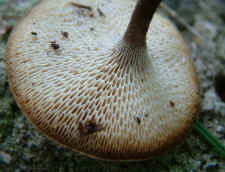 Stem:
2-4cm high and about 0.5cm thick.
Stem:
2-4cm high and about 0.5cm thick.
Pores: Relatively large, easily seen by the naked eye, yellowish or
light orange brown in colour. Runs down the stem.
Spore print: White.
Edibility: Not edible
Note: This
 mushroom
is not very common.
mushroom
is not very common.

Polyporus sp.

Found in Te Mata Trust Park in Havelock North in July, 2000. On dead wood
under a tree in a cluster of three mushrooms.
Cap: Fan shaped, laterally joined to the stem. Topside dark gray in
colour and covered in black hairs. Cap margin in curved.
Pores: Pore surface white. Small, barely visible pores, looks smooth
to the naked eye. Running down the stem.
Stem: 0.5-1cm thick and 1.5-3cm high. Dark brown to black in colour.
Numerous stems attached in a cluster from the base.
This mushroom was growing in a very dark corner under
 a
tree, I still can't imagine how I managed to see it.
a
tree, I still can't imagine how I managed to see it.
I have not been able to identify this mushroom's species but I am still
working on it. If you have any clues please let me know.
Edibility: Unknown. ( If in doubt, throw it out!!)
Group: Stereaceae (Crust and
Parchment Fungi)
Thin bracket like mushrooms. Some have stems others don't. Pore layer smooth or wrinkled.
Sterium Fasciatum
Found in Te Mata Trust Park in Havelock North, Tangoia Falls in Hawkes Bay
and In the Manawatu Gorge Track through out July, 2000.
Cap: Thin and bracket like. Sometimes growing flat on wood surface as
if it were a stain but often separating
 from
the wood surface to form a shelf like
structure. Upper surface smooth to
velvety, yellow to orange in colour darkest at connection withthe host and
the colour growing paler towards the
margin evntualy becoming white at the edge.
from
the wood surface to form a shelf like
structure. Upper surface smooth to
velvety, yellow to orange in colour darkest at connection withthe host and
the colour growing paler towards the
margin evntualy becoming white at the edge.
Pore layer: Smooth. White or yellowish in colour. Pores are barely
visible.
Stem: Absent.
Edibility: Too tough
Group: Trametes
This group of annual mushrooms can be found year round. They are tough and
grow in large numbers on dead wood. Caps have concentric zones and are more
or less velvety.
Pycnoporus Coccineus - (Cinnabar or Red
polypore)
Found at the Tangoia scenic reserve in Hawkes Bay on September 16, 2000
growing from a dead cabbage tree log.
I was quite excited when I found this mushroom because of it's colour, a
spectacular bright red to orange all over. The cap colour faded a little to
a pale orange but the pores maintained their magnificent colour.
Cap: about 3-9cm wide.

No stem, broadly attached to the host.
Pore layer about 1-2mm deep, about 4-5 pores/mm.
Flesh: Orange and thickest at connection to host, about 1.5cm thick.
Edibility: Too tough, not edible.
Supposed to be quite rare.
Trametes Versicolor (The Turkey Tail)

This mushroom was found on a dead tree stump in a line of shelter belt trees
in an orchard. It was a spectacular site especially when the whole tree
stump was covered by them, but most of them were destroyed by an orchard
lawn mower before I got to them!!
Cap: Thin, upper surface with concentric zones of black, brown white yellow
and often red. Zones alternate, some are smooth and others are velvety or
hairy.
About 2-8 cm wide.
 Pores:
Surface white to slightly yellowish small but seen by the naked eye.
Pores:
Surface white to slightly yellowish small but seen by the naked eye.
Stem: Absent
Edibility: Believe it or not, it is supposed to be edible, but you
need to boil it for like 3 days first
I would leave this one untasted for now anyway
This mushroom is very very common.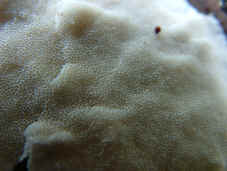
Trametes hirsuta (Hairy turkey tail)
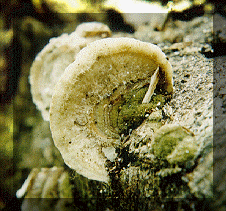
Found at Tangoia Falls on October 5th, 2000.
Growing on a dead fallen tree.
This mushroom is quite interesting, the hairs covering it's surface are quite striking. The hairs are white or silver in colour while the cap surface is mostly whitish but is concentrically zoned.
Zones are not as distinctly different in colour as in T. versicolor.
About 2-10cm in
diameter, grows shelf like from wood,
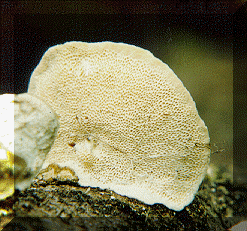 single
or in groups as in this one.
single
or in groups as in this one.
Pore Surface white and attractive in appearance.
Stalk absent, broadly attached to the host
It's texture is not too tough and not soft, similar to T. versicolor.
Edibility: I would not have thought so, but like T. versicolor it is known to be edible but also needs a long cooking period

Unknown Polypores
The following Mushrooms I have not been able to identify, if you have any
clues as to what they are please contact me and let me know!!
Unknown 1

Found growing on dead wood at the Gorge Track in Palmerston North.
Top surface light brown in colour and uneven. 3-4cm wide.
No stem but broadly attached to it's host.
Pore surface an amazing bright yellow, a big surprise on turning this
mushroom over, from the top it is nothing exciting but the lower surface is
quite fascinating due to it's colour.
 Edibility:
I don't know what it is, so I don't know if it is edible, but I would guess
not because it is rather tough and small
Edibility:
I don't know what it is, so I don't know if it is edible, but I would guess
not because it is rather tough and small
WARNING
Different people react differently to different mushrooms.
NEVER eat a wild mushroom without being 100% sure it is safe to do so.
Best Gourmet Mushrooms in New Zealand
Best Gourmet Mushrooms in New Zealand
Best Gourmet Mushrooms in New Zealand
Best Gourmet Mushrooms in New Zealand
Best Gourmet Mushrooms in New Zealand
Best Gourmet Mushrooms in New Zealand
Best Gourmet Mushrooms in New Zealand
Best Gourmet Mushrooms in New Zealand
Last Update
17 Feb 2007